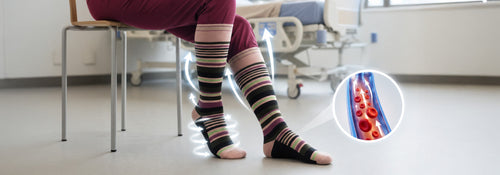
compression levels
Compression Sock Levels Explained: 15–20, 20–30 and 30–40 mmHg
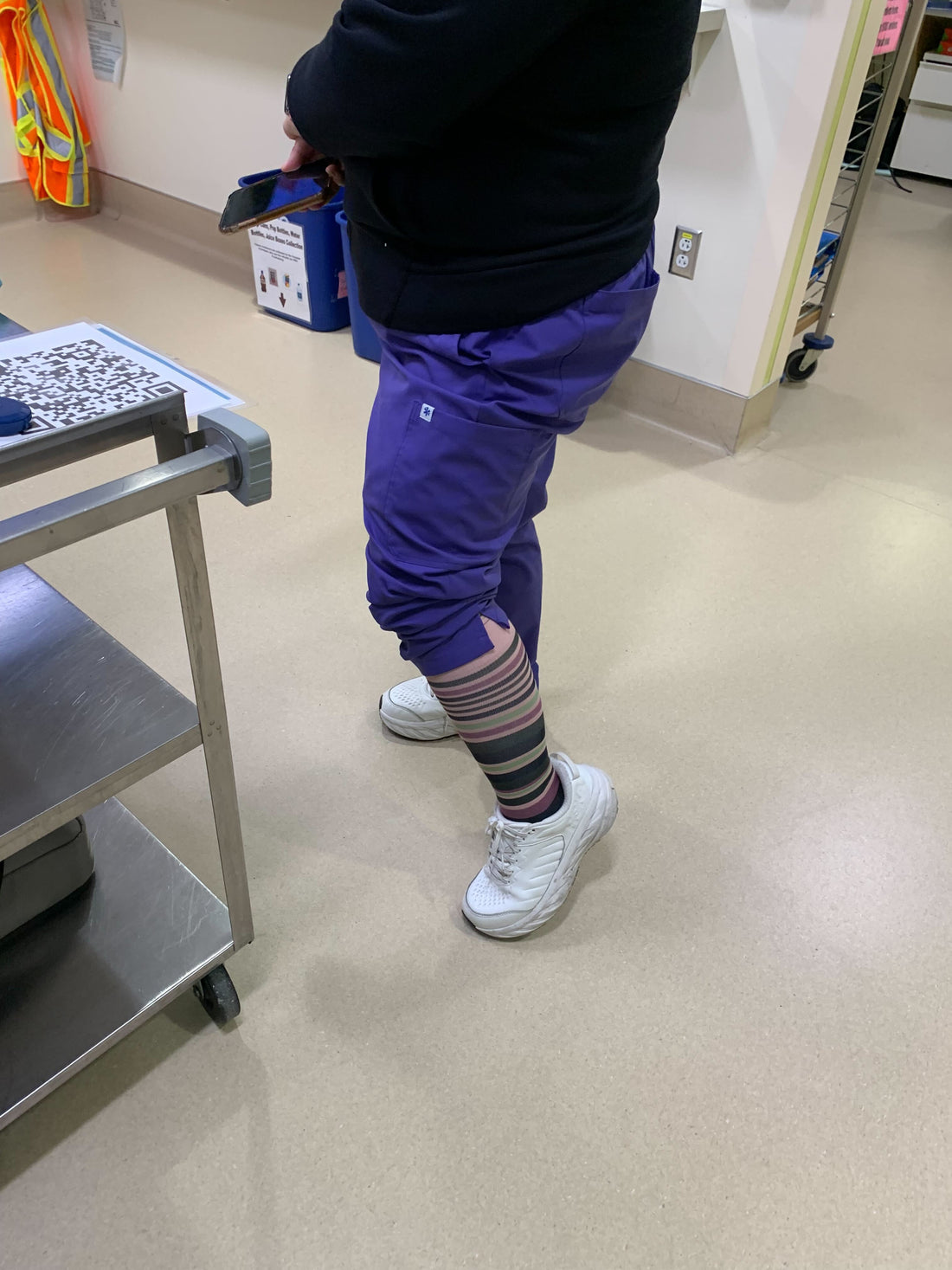
The short answer: compression socks are graded by pressure, measured in millimetres of mercury (mmHg) — the same unit used for blood pressure. The pressure is graduated: firmest at the ankle, easing up the calf. There are three common levels. 15–20 mmHg is the everyday level, for long days on your feet, travel, and mild end-of-day swelling. 20–30 mmHg is medical-grade support, for noticeable swelling, varicose veins and recovery. 30–40 mmHg is firmer again and is prescribed for specific clinical conditions — it isn't a step up you choose for yourself. Higher is not better; the right level is the one that matches your situation.

What does mmHg mean?
mmHg stands for millimetres of mercury — a unit of pressure, the same one your blood pressure is measured in. On a compression sock, the mmHg figure tells you how much pressure the sock applies at the ankle, where it's firmest.

A range like 15–20 mmHg means the sock delivers between 15 mmHg and 20 mmHg of pressure at the ankle, easing as it travels up your leg. That gradient is the whole mechanism — we cover how it works in how compression socks actually work.
One thing worth saying plainly: a bigger mmHg number isn't a better sock. It's a different tool for a different job.
15–20 mmHg — the everyday level
This is where most people should start, and it's the level people are most surprised by, because it's genuinely comfortable.
15–20 mmHg is for:
- long days standing or sitting — shifts, desks, travel
- mild swelling in your feet and ankles by evening
- that heavy, tired, aching feeling at the end of the day
- anyone new to compression who wants support without feeling gripped

This is also the preventative level — for the tired legs you have now, not only for a diagnosis you already have. That's the part nobody explains, and it's why most people never try compression at all.
Our everyday ENERGY socks at 15–20 mmHg are a moisture-wicking cotton blend with a wide, non-digging comfort top, flat-felled seams, a terry-cushioned footbed and an antimicrobial silver-ion wash — because the reason people abandoned compression was never whether it worked, it was that the socks were hot and uncomfortable. Browse the 15–20 mmHg range.
On coverage: in Canada, plans generally require 20 mmHg or above, so 15–20 mmHg is generally not claimable — always check your own plan.
20–30 mmHg — medical-grade support
20–30 mmHg is a noticeable step firmer, and it's the level most often recommended when there's something more than everyday tiredness going on:
- noticeable or persistent swelling
- varicose veins
- recovery situations, on a clinician's guidance
- long clinical shifts where 15–20 mmHg isn't quite enough

If you're choosing between 15–20 mmHg and 20–30 mmHg, that's worth mentioning to your doctor — particularly if you're managing a circulation condition, diabetes or neuropathy. And an important distinction: if you've been prescribed 20–30 mmHg, a 15–20 mmHg sock is something you might wear alongside it on easier days, never instead of it.
Browse 20–30 mmHg.
30–40 mmHg — a clinical decision
30–40 mmHg is a clinical decision, not a shopping upgrade. It's prescribed for specific conditions and it isn't right for everyone — if you're curious whether it's appropriate for you, that's a conversation for your practitioner, not for us.
It's prescribed for situations like significant venous disease, post-thrombotic syndrome and severe lymphedema. It can cause real harm without a clinical indication — particularly for anyone with arterial insufficiency or neuropathy.
So there's no "browse this level" link here, and that's deliberate. If a practitioner has you in 30–40 mmHg already, your plan may cover additional pairs — often under a separate quantity allowance — and that's worth checking. If you're simply wondering whether firmer would be better, the honest answer is that it's not a question we can answer for you.
Are compression socks covered by insurance in Canada?
Often, yes — but it depends entirely on your own plan, so the useful thing is knowing how to check rather than taking anyone's word for it.
As a rule of thumb, Canadian extended health plans generally require 20 mmHg or above. That means 20–30 mmHg and 30–40 mmHg are typically eligible, while 15–20 mmHg generally isn't. You may have coverage through your plan — check with your provider for your specific amounts and any documentation they need.
Two things worth knowing either way:
- There's no direct billing anywhere, including Blue Cross. You pay, submit an itemised receipt, and get reimbursed. The process is identical whether you buy online or in person.
- Benefits reset January 1 and unused coverage is forfeited — use it or lose it.
We go through the whole process step by step in does Canadian insurance cover compression socks?
Coverage varies by insurer, province and employer. Nothing here is medical advice or a guarantee of reimbursement — check your plan, and speak to your practitioner.
So how do you choose a compression level?
A short version:
- Start with why. Tired, achy legs after a long day → 15–20 mmHg. Noticeable swelling, varicose veins, or a clinician's recommendation → 20–30 mmHg. A specific diagnosis → your practitioner decides.
- Don't reach for a higher number hoping for a better result. Higher mmHg isn't stronger medicine, it's a different indication — and too much compression is uncomfortable at best.
- Get the fit right before worrying about the level. A poorly fitted sock loses the gradient that makes any level work. Our guide to how compression socks should fit covers measuring.
- Ask if you're unsure. If you have a circulation condition, diabetes or neuropathy, it's worth mentioning to your doctor before you choose.
Still weighing it up? Our compression guide walks you through it, and you can see the full range of compression socks by level.
Frequently asked questions
What does mmHg mean on compression socks?
mmHg means millimetres of mercury, a unit of pressure — the same one used for blood pressure. On a compression sock it's the pressure applied at the ankle, where the sock is firmest.
What are the compression sock levels?
The three common levels are 15–20 mmHg (everyday), 20–30 mmHg (medical-grade support) and 30–40 mmHg (prescribed for specific clinical conditions).
What does 20–30 mmHg mean?
It means the sock applies between 20 mmHg and 30 mmHg of pressure at the ankle, easing up the leg. It's medical-grade support, typically for noticeable swelling, varicose veins or recovery.
Which compression level do I need?
15–20 mmHg suits long days, travel and mild end-of-day swelling. 20–30 mmHg suits noticeable swelling or varicose veins. 30–40 mmHg is a clinical decision made with a practitioner. If you're unsure, it's worth mentioning to your doctor.
Is a higher mmHg better?
No. A higher number isn't a stronger version of the same thing — it's a different indication, and too much compression is uncomfortable and can be inappropriate without a clinical reason.
Are compression socks covered by insurance in Canada?
Canadian plans generally require 20 mmHg or above, so 20–30 mmHg and 30–40 mmHg are typically eligible while 15–20 mmHg generally isn't. Coverage varies — check your own plan. There's no direct billing; you pay and submit an itemised receipt for reimbursement.
This article explains what the levels mean. It isn't medical advice and it isn't a diagnosis. If you have symptoms that worry you — sudden or severe swelling, swelling in one leg with pain, warmth or redness, or chest pain or shortness of breath — please contact your doctor or go to your nearest emergency department.
Recommended by Dr. Johnny's
Surgeon-designed for comfort and healthy circulation — with free shipping on orders over $30 CAD.
Shop →About the author
Dr. Jean Segal is a surgeon with more than 35 years treating venous disease, and the founder of Dr. Johnny's. He designs every sock and foot-care product to support circulation and comfort at every age.
Feet-first, straight to your inbox
Practical foot-health tips from Dr. Segal. No spam — unsubscribe anytime.