compression socks
How Compression Socks Actually Work — A Surgeon Explains

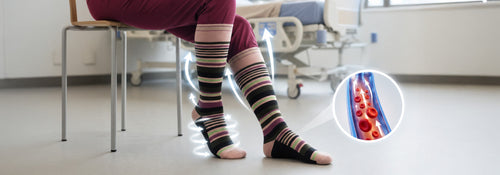
The short answer: compression socks work by applying graduated compression — measured pressure that is firmest at the ankle and eases gradually up the calf. That gradient supports the veins carrying blood back up your legs against gravity, and works together with your calf muscle, which acts as a pump every time you take a step. The key point most people miss: it isn't tightness that does the work, it's the gradient. A sock that squeezes evenly all the way up isn't graduated compression at all.
What is graduated compression?
Graduated compression means the pressure is deliberately uneven by design. It's strongest at the ankle, where blood has the furthest to travel upward, and it eases as it moves up your calf — encouraging flow in one direction rather than simply constricting your leg.
That pressure is measured in millimetres of mercury (mmHg), the same unit used for blood pressure. Everyday compression starts around 15–20 mmHg; medical-grade support is 20–30 mmHg; 30–40 mmHg is firmer still and prescribed for specific clinical situations. We break the levels down properly in compression levels explained.

Why are compression socks tightest at the ankle?
Because that's where the job is hardest. Blood in your feet and ankles has the longest climb back toward your heart, and it's fighting gravity the whole way. Concentrating the firmest pressure at the ankle and reducing it up the leg gives that flow a consistent nudge in the right direction. Reverse it — tight at the top, loose at the ankle — and you'd be working against the very thing you're trying to help, which is exactly the problem with a sock that has one tight elastic band at the top.
Your calf is a pump — compression helps it work
Your calf muscle is sometimes described as a second heart, and it's a fair description. Every step you take squeezes the deep veins in your calf and pushes blood upward; valves inside those veins are meant to stop it falling back down between steps.

The trouble is that this system depends on movement. Sit through a long flight, stand through a twelve-hour shift, or spend the day at a desk, and the pump barely fires — so blood and fluid settle in your lower legs. That's the heavy, tired, puffy feeling by evening. Graduated compression supports the vein walls and valves so that pump works more effectively, and keeps supporting them through the hours you're not moving much.
Why "just tight socks" don't do the same thing
This is the most common misconception we hear, and it matters:
- Uniform tightness has no gradient. An ordinary sock that feels snug is snug everywhere, so there's nothing directing flow upward.
- One tight band concentrates pressure in a single spot. That's what leaves the deep red rings people ask us about — and a band digging into one narrow point isn't support, it's constriction. More on that in what sock marks really mean.
- Real compression is engineered and measured. Graduated compression socks are knit to hold a specified pressure profile in mmHg. A regular sock isn't made to any pressure specification at all.

Dr. Johnny's socks are surgeon-designed with a wide, non-digging comfort top and flat-felled seams, so the support comes from the gradient rather than from a band biting into your calf.
The part nobody explains: this isn't only for a diagnosis
Compression has a reputation as something you're prescribed after something goes wrong. That's a big part of why people don't try it. But the tired, aching, heavy legs you have now — after a shift, a flight, a long day standing — are exactly what everyday compression is for.
Dr. Jean Segal spent 35 years treating venous disease, and Dr. Johnny's exists because the socks his patients needed were socks nobody wanted to wear: they looked medical, they were hot and uncomfortable, and nobody ever explained the preventative part. Understanding the mechanism is the whole point — once you know it's a gradient supporting a pump, "why would I wear these?" answers itself.
How to make it actually work for you
The mechanism only delivers if the sock fits and you wear it at the right time:
- Put them on first thing in the morning, before fluid has had a chance to settle.
- Get the size right. Too small and you lose the gradient — you get a tourniquet instead of a graduated profile. Our guide to how compression socks should fit walks through measuring.
- Smooth, never bunched. A rolled or folded cuff creates a pressure point.
- Replace them. Compression fades after about six months of regular wear, and a stretched-out sock has lost the gradient that made it work.

If you're not sure which level suits your day, our compression guide helps you narrow it down, and you can browse the full range of compression socks by level. If you have a circulation condition, diabetes, neuropathy or any concern about your legs, it's worth mentioning to your doctor before starting compression.
Frequently asked questions
How do compression socks work?
They apply graduated compression — firmest at the ankle, easing up the calf — which supports the veins returning blood up your legs and works with your calf muscle pump. The gradient does the work, not the tightness.
What does graduated compression mean?
Pressure that is deliberately strongest at the ankle and decreases up the leg, measured in mmHg, to encourage flow in one direction rather than simply constricting the leg.
Why are compression socks tighter at the ankle?
Blood in the ankle has the furthest to travel upward against gravity, so concentrating pressure there and easing it up the leg gives flow a consistent push in the right direction.
Are compression socks just tight socks?
No. An ordinary tight sock is snug evenly, or has one tight band at the top, so there's no gradient — and a single tight band can leave deep marks. Graduated compression is knit to a measured pressure profile in mmHg.
How long do compression socks keep working?
Compression fades after about six months of regular wear and washing. A stretched-out sock has lost the gradient that made it effective.
This article explains how compression works. It isn't medical advice and it isn't a diagnosis. If you have symptoms that worry you — sudden or severe swelling, swelling in one leg with pain, warmth or redness, or chest pain or shortness of breath — please contact your doctor or go to your nearest emergency department.
Recommended by Dr. Johnny's
Surgeon-designed for comfort and healthy circulation — with free shipping on orders over $30 CAD.
Shop →About the author
Dr. Jean Segal is a surgeon with more than 35 years treating venous disease, and the founder of Dr. Johnny's. He designs every sock and foot-care product to support circulation and comfort at every age.
Feet-first, straight to your inbox
Practical foot-health tips from Dr. Segal. No spam — unsubscribe anytime.